Signs That Perimenopause Is Ending
Recognize the hormonal and menstrual patterns that mark perimenopause's final stage.

Perimenopause doesn't end with a signal flare. It ends with an absence: twelve consecutive months without a period, confirmed only after the fact, which means most women spend a long stretch not knowing whether what they're feeling is the beginning of the end or just the middle dragging on. I've spent enough time in this territory, both reading the research and talking to women living it, to know the late stage leaves clues. This piece walks through the menstrual, hormonal, and symptomatic patterns that mark the closing stretch of the transition, so the picture makes sense while it's happening instead of only in hindsight.
How clinicians define the late stage of perimenopause
Researchers use a staging system called STRAW+10, revised in 2012. It's the backbone of the clinical literature on reproductive aging, and it treats perimenopause as a run from Stage -2 through Stage +1a. People tend to talk about "perimenopause" like it's one flat experience, but the stages aren't interchangeable.
Early perimenopause, Stage -2, shows up as cycles that start varying by seven or more days between consecutive periods. Late perimenopause, Stage -1, looks different: the gaps between periods widen considerably, and the hormonal decline, still uneven, starts settling into something more consistent. Stage 0 is the final menstrual period itself, though nobody can name it as final while it's happening. Stage +1a is the twelve-month wait afterward, and yes, a woman is technically still in perimenopause for that entire year, even though her body already had its last cycle months earlier.
Clinicians watch for a 60-day gap between periods as the practical marker, and crossing that threshold is a fairly strong sign the late stage has started. Age tells you less than you'd think; the average age of final menstrual period in the U.S. lands in the early-to-mid fifties, but the spread is wide enough that using age as a diagnostic shortcut is a mistake. Two 49-year-olds can be standing in completely different rooms of this process.
The menstrual pattern that signals the final stretch
Infrequent periods are the most reliable sign that perimenopause is winding down. Mood swings, sleep trouble, and hot flashes each carry their own weight, but cycle spacing does most of the telling.
The pattern moves in phases. Early on, cycles shorten or lengthen unpredictably, and flow changes without much logic to it, heavier one month, lighter the next. In the middle stretch, that variation gets more pronounced, with occasional skipped periods thrown in. By the late stage, the gaps stretch progressively longer, and when periods do show up, they're often lighter and shorter than what a woman remembers from her thirties.
That 60-day mark is useful, but don't treat it like a rulebook. Occasional heavy or unexpected bleeding can still happen deep into late perimenopause; the signal is infrequency, not a clean, declining slope. Anyone expecting a tidy taper toward nothing will get thrown off when a heavy period shows up after three months of quiet, since that's still consistent with late perimenopause. What matters is the overall drift toward longer gaps, not what any single cycle decides to do.
This is where tracking actually earns its keep, and I don't mean that as a wellness platitude. A cycle-length log, even a rough one kept in the Notes app on your phone, gives a woman real data instead of a vague sense that "it's been a while." Once the final period happens, the twelve-month countdown starts, though she won't know which period was the last one until the year has quietly passed without another.
What happens to FSH and estradiol as perimenopause winds down
The broad direction isn't complicated: estrogen and progesterone decline, FSH climbs, because the pituitary gland is pushing harder to stimulate ovaries that respond less and less. What trips people up is how estradiol behaves along the way.
Estradiol doesn't fall in a straight line. In early and middle perimenopause it can spike sharply, sometimes higher than premenopausal baseline, before dropping again. That erratic swinging produces a lot of the transition's worst symptoms. A woman can feel genuinely awful while her estradiol reading looks perfectly normal, because the blood draw caught her mid-swing instead of at the high or low that actually caused the symptom. By late perimenopause, that volatility tends to calm down. Estradiol settles into a more consistently low range, with less of the dramatic spiking from the earlier years.
Progesterone takes a more predictable road. As ovulation happens less often, progesterone drops steadily, and by late perimenopause, regular ovulatory cycles are rare enough that progesterone sits low most of the time.
FSH is the number most people fixate on, and there's a reason for that. Levels above roughly 25 to 40 IU/L on repeated measurement line up with late perimenopause and menopause. Repeated is doing the heavy lifting in that sentence: a single elevated reading means far less than a value that stays elevated across several tests. There's also newer research suggesting FSH isn't just a passenger reflecting ovarian slowdown; it may act directly on bone tissue and play an independent role in bone loss during this window. If that holds up under more study, FSH becomes something worth watching in its own right, beyond its role as a proxy for where a woman stands in the transition.
So the hormonal picture in late perimenopause tends to look like this: FSH trending upward, estradiol more consistently low with less spiking, progesterone parked near the floor.
How hot flashes and night sweats behave at the end of the transition — and after
Vasomotor symptoms, the umbrella term for hot flashes and night sweats, affect up to roughly three-quarters of women moving through perimenopause. A 2025 study on moderate-to-severe symptoms found that hot flashes showed the biggest jump in prevalence between the late reproductive years and late perimenopause. They're often intensifying right as the transition heads toward its close, rather than fading out gently the way you'd hope.
A lot of outdated expectations need correcting here. The SWAN study, a major longitudinal effort, overturned the old idea that hot flashes last six months to two years. The median total duration in that dataset ran to years, not months. Even more striking: women whose hot flashes started while they still had regular periods, earlier in the transition, experienced symptoms that lasted considerably longer than women whose vasomotor symptoms only kicked in after their periods had already stopped. Timing of onset predicts duration, and starting early means the thing tends to overstay its welcome.
So what does that mean if you're trying to read your own late-stage signals? A drop in hot flash frequency can be a meaningful marker that the transition is closing. Persistent, unabated hot flashes carry a murkier message, since plenty of women carry vasomotor symptoms well into postmenopause. The end of periods and the end of hot flashes are two separate clocks, and nothing forces them to run in sync.
Other symptoms that shift in late perimenopause — and what those shifts mean
Sleep tends to get worse, not better, as perimenopause reaches its later stages. Some of that is mechanical: night sweats interrupting rest. But research also points to hormonal effects on sleep architecture that operate independently of sweating entirely. A woman can have a dry, cool night and still sleep terribly, because the hormonal shifts are touching sleep regulation directly, not just triggering sweat.
Vaginal and genitourinary symptoms follow a completely different trajectory, and this distinction matters more than people give it credit for. Dryness often increases as the final period approaches, since consistently lower estradiol reduces the support mucosal tissue relies on. Hot flashes eventually taper for most women; genitourinary symptoms tend to persist and even worsen after menopause instead of resolving on their own. One category gets better with time, while the other doesn't, not without treatment.
Mood and cognition round out the picture. Irritability, low mood, and memory trouble show up across the whole transition, but they can feel sharper in late perimenopause, when hormone levels go consistently low instead of swinging erratically. And the population-level numbers back this up: the global burden of anxiety disorders in perimenopausal women rose from 625.51 per 100,000 in 1990 to 677.15 per 100,000 in 2021, with projections reaching 1,180.43 per 100,000 by 2035. That's a projected 40.67% increase over 2021 levels. Numbers like that make it hard to treat the mood side of perimenopause as a footnote.
What actually matters diagnostically is a change in symptom character, not just when a symptom first shows up. A woman who's been paying attention to her own patterns notices a shift in intensity or timing far faster than one who only checks in when things feel unbearable.
Why a single hormone test can't tell you where you are in the transition
FSH is the most commonly ordered test for assessing perimenopause and menopause, and it's also one of the most commonly misread. The assumption that one result tells a complete story is where the trouble starts.
FSH fluctuates across cycles and even within a single cycle. A reading that looks normal one week can be elevated the next. Estradiol and FSH can even seem to contradict each other in the same blood draw during perimenopause, since the fixed relationship between the two hormones that existed before the transition no longer holds. A single elevated FSH doesn't confirm menopause, and a single normal FSH doesn't rule out late perimenopause. Either result, taken alone, can send you the wrong way.
For women over 45, some clinical guidelines actually say FSH testing isn't strictly necessary to diagnose perimenopause; the menstrual and symptom picture is often enough on its own. For women under 45, or in cases where the picture stays genuinely murky, testing matters more, partly to track the transition and partly to rule out other explanations. Thyroid dysfunction in particular produces overlapping symptoms, irregular cycles, fatigue, mood changes, sleep trouble, and it should get ruled out before everything gets pinned on perimenopause by default.
The real value lies in testing repeatedly rather than relying on frequency or volume alone. What one test can't show, a series of tests over months can. FSH trending upward over time carries far more information than any single value pulled from one draw.
What tracking hormone levels over time reveals that a snapshot cannot
Cross-sectional studies, the kind that measure hormones at one point in time across a group of women, run into an obvious limit: they capture a moment, never a trajectory. Longitudinal research fills that gap. The Swiss Perimenopause Study followed 127 women over 13 months with repeated hormone sampling, and what it showed is that within-person patterns over time reveal things a single snapshot just can't.
A series of tests answers questions a snapshot can't touch. Is FSH genuinely climbing over months, consistent with late perimenopause, or bouncing around without direction? Is estradiol variability narrowing, becoming more consistently low, the signature of the later transition? Is progesterone holding steady at the floor, consistent with infrequent ovulation? None of that shows up in one data point.
Tracking also builds something like a personal baseline. Knowing where your own numbers sat two years ago makes today's reading legible in a way a stranger's reference range never quite manages. Though raw numbers over time still need a clinician's eye; the pattern across tests requires interpretation, not just a glance at the most recent value. Data without context tends to produce anxiety more than answers, which rather defeats the point of tracking at all.
A woman who walks into a clinical conversation with months of data behind her stands in a different position entirely than one holding a single result. She can point to a trend line, which is a different kind of evidence than a number floating on its own.
How to tell late perimenopause from the years preceding it — and from early postmenopause
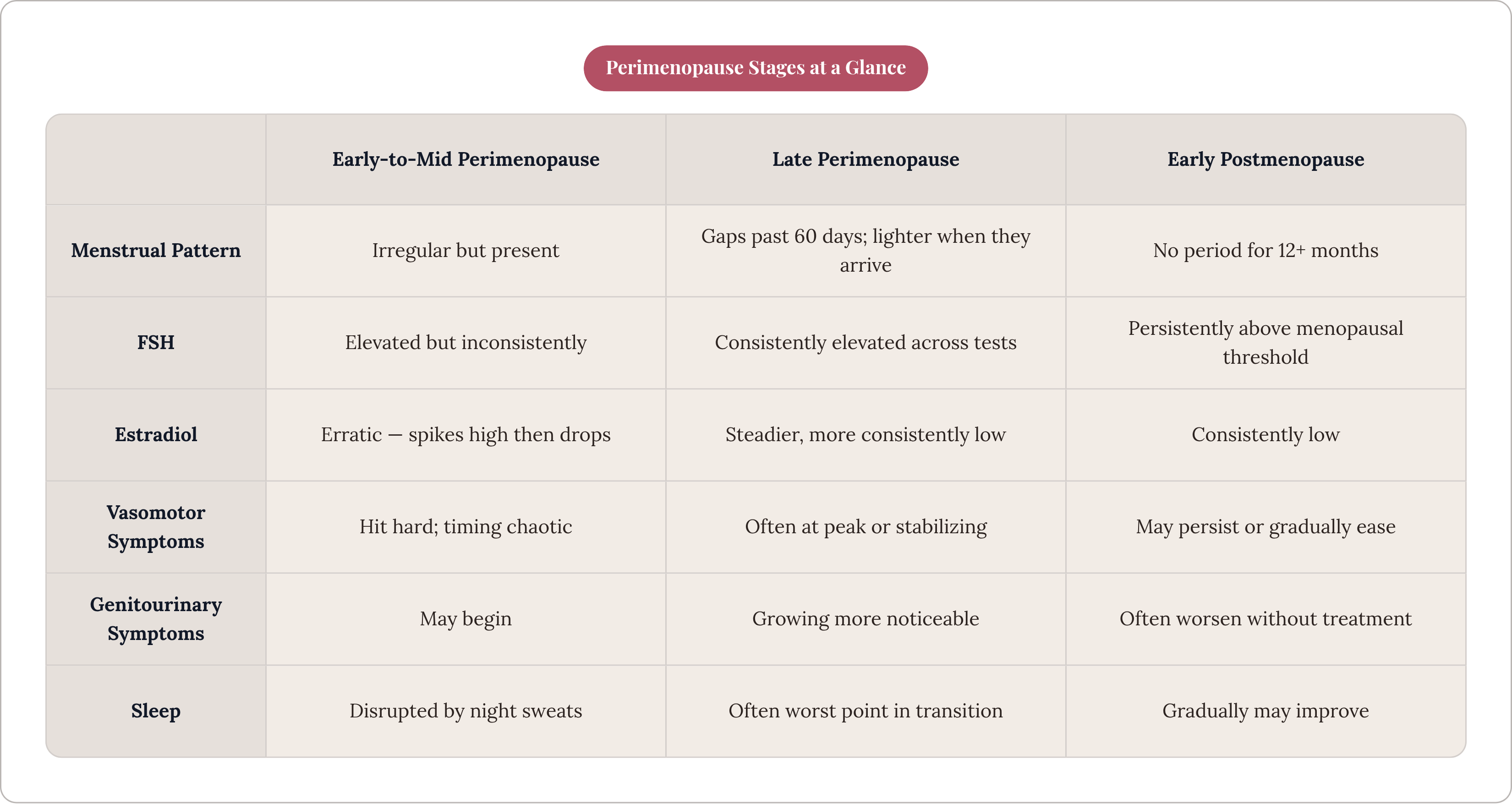
Laid side by side, the three stages stop blurring together and start looking distinct.
Early-to-mid perimenopause: cycles vary unpredictably but still show up with some regularity. FSH runs elevated, but inconsistently. Estradiol spikes high and drops, erratic rather than persistently low. Symptoms can hit hard, but the timing feels chaotic, coming and going without an obvious pattern to it.
Late perimenopause: periods stretch past 60 days apart and, when they arrive, tend to be shorter and lighter. FSH turns more consistently elevated across repeated tests. Estradiol settles into a lower, steadier range, with the spiking mostly behind her. Vasomotor symptoms might be at their peak, or starting to stabilize, depending on the woman. Genitourinary symptoms grow more noticeable, and sleep quality often hits its worst point in the entire transition right here.
Early postmenopause, the first year after the final period: no period for twelve or more consecutive months. FSH sits persistently above the menopausal threshold. Estradiol stays consistently low. Some symptoms, hot flashes and mood changes among them, can keep going, and genitourinary symptoms often keep worsening rather than settling down.
Here's the honest complication, though: because menopause can only be confirmed retrospectively, a woman ten months into a period-free stretch is still, technically, in perimenopause. She doesn't get to call it early. But the pattern across menstrual timing, FSH trend, and symptom shift gives her real evidence she's in the final corridor, even before the exact door closes. That's the value of comparing the three stages this way: the shape of the whole picture over time, rather than one test or one data point.
Using these signals to advocate for yourself in clinical settings
Perimenopause symptoms get misattributed constantly, to stress, to depression, to thyroid problems, or dismissed outright as ordinary aging. Late perimenopause doesn't get a pass from this; if anything, the ambiguity of the "am I done yet" question makes it easier for a clinician to wave off complaints as something else entirely.
The strongest thing a woman can bring into an appointment is a record. A menstrual log showing cycle-length changes over several months carries more weight than "my periods have been weird lately." A symptom record noting not just what happened but how it changed, in intensity, frequency, timing, gives a clinician something to actually work with instead of a vague impression. Prior hormone test results, especially a series rather than one draw, let a provider see a trend instead of guessing from a number pulled out of context.
None of this replaces clinical judgment, and it shouldn't try to. But walking in with a menstrual log and a symptom timeline changes the entire shape of the conversation, from "tell me how you feel" to "here's what's been happening, and here's the pattern." One of those gets you heard on the first visit, while the other, too often, gets you a follow-up appointment in six months.